







PadelGuru analysis
Verdict
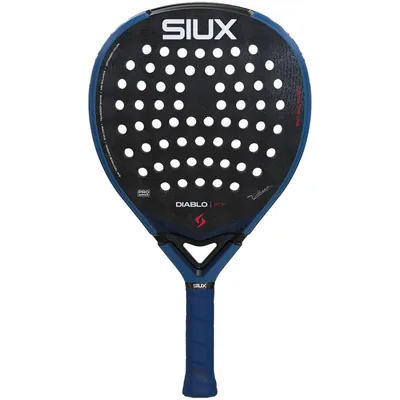
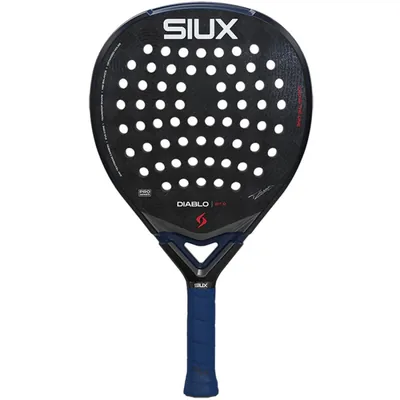
The Siux Diablo Pro Royal Blue 2026 is a hybrid racket built for intermediate-to-advanced and advanced players who construct the point through discipline, the bandeja and the vibora rather than sheer power. Tino Libaak’s competition racket stands out for a crisp, dry feel that gives clear feedback on the ball and a generous margin for error at medium pace.
Our verdict places it as a highly reliable offensive-control option for working the point, though demanding if you look to finish rallies with raw power. When the rally reaches top speed or you go for a flat smash, the face absorbs part of the impact and forces you to accelerate your arm with conviction.
- Best for
- Technical players who build the point with the bandeja, vibora and tidy defense while looking for a crisp, precise feel.
- Not for
- Big hitters who base their game on flat smashes and full-speed flat volleys.
Strengths
- Crisp, dry impact that delivers high precision when placing the ball
- Easy ball exit in defense at slow and medium pace
- Excellent control for putting weight on the bandeja and vibora
- 3D textured surface combined with a sandy finish on the faces
- Larger sweet spot than usual for a hybrid racket
Weaknesses
- On flat smashes, the face absorbs energy and demands heavy arm acceleration
- Fast rallies from the baseline require a long, full follow-through
- Slightly slower on net block volleys than the previous edition
- Loses noticeable ball exit on high contact toward the tip of the head
01 Back of the court: comfortable defense at medium pace
Defending at slow or medium speeds is straightforward because the ball comes off the face naturally without forcing you to lengthen your swing. Its sweet spot, slightly larger than standard, helps dig out awkward balls near the back glass and makes it a more forgiving racket at the baseline than stiffer alternatives from the brand.
That behavior shifts when your opponents press and the ball comes in fast. Because it is not a high-stiffness racket, the ball sinks deeper into the face during rapid exchanges, requiring you to hit firmer and follow through completely so your shot does not fall short.
02 Volley: built for slice and working the point
At the net, it rewards players who use slice and look for depth rather than an outright winner. Its dry response lets you find the angles with real confidence, although in rapid reflex exchanges it handles a touch slower than its predecessor due to a slightly higher medium balance.
If you try to finish the point with a hard, flat volley, the face tends to give on impact and produces less rebound speed than firmer rackets such as the Electra, the Pegasus or the Fenix.
03 Overhead play: authority on the bandeja and vibora
The bandeja and the vibora are its standout shots. You can load the ball with heavy spin and placement without worrying about floating it into the back glass. Only when the rally is played at a very high tempo do you need to swing faster, as the ball tends to dwell slightly on the face.
On the flat smash, the face gives upon impact and absorbs part of the energy, punishing contact made above the center toward the tip with a clear drop in ball exit. By contrast, it responds better on the x3 smash, offering extra help to kick the ball out over the side wall.
04 Feel and construction: crisp yet medium-soft stiffness
Combining a Black EVA core with an inner layer of 3K carbon and an outer layer of 24K carbon produces a dry, crisp strike that never feels overly stiff. Within the Siux lineup, it sits above the Valkiria Pro and the Trilogy Pro in firmness, yet below the brand’s hardest attacking lines.
The mold features a smaller, narrower throat and a 13 cm handle that makes for a comfortable grip, finished off with a 3D textured pattern and a sandy finish across the faces.
05 How it changes compared to the Diablo 4 Pro
The update over the Siux Diablo 4 Pro focuses on gaining precision and bite on the ball. It drops the smooth surface in favor of the dual rough texture, steps up slightly in stiffness thanks to the 24K over 3K carbon layup, and introduces a more closed throat bridge. With that structural tweak and a slightly higher balance, it trades a fraction of quickness on block volleys for a far superior sense of control across the entire court.
Frequently asked questions
- What racket does Tino Libaak use?
- Tino Libaak competes with the Diablo Pro 2026, a medium-soft hybrid racket built with 24K and 3K carbon for players who prioritize overhead placement and steady baseline defense.
- Is the Diablo Pro 2026 a stiff or soft racket?
- It sits at a medium-soft stiffness paired with a dry, crisp feel on contact. It is less rigid than Siux's dedicated power rackets, making it forgiving at moderate speeds even if the face pockets the ball slightly on full-power flat shots.
- Is the Diablo Pro 2026 hard to maneuver?
- Not at all: its medium balance keeps it from feeling head-heavy or physically taxing, offering standard handling around the court. It only feels marginally slower than last year's model during quick-fire volley exchanges at the net.
- How does the Diablo Pro 2026 perform on the smash?
- It is much more effective on the x3 smash than on flat power smashes. Because the face flexes when you hit flat and takes away rebound speed, you need clean central contact and a fast arm swing to finish points overhead.