







PadelGuru analysis
Verdict
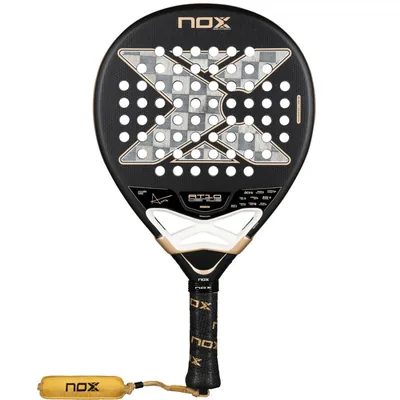
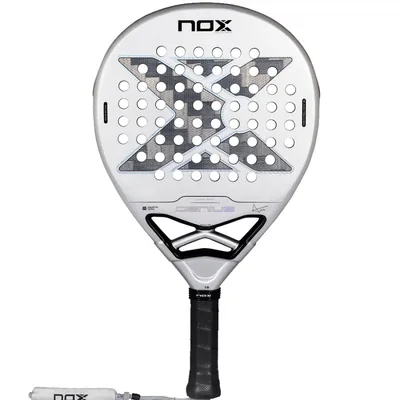
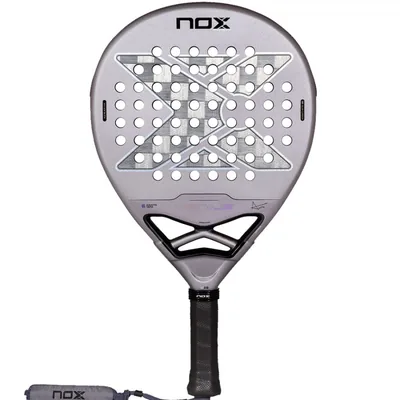
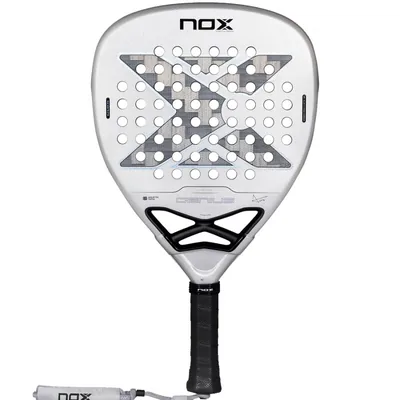
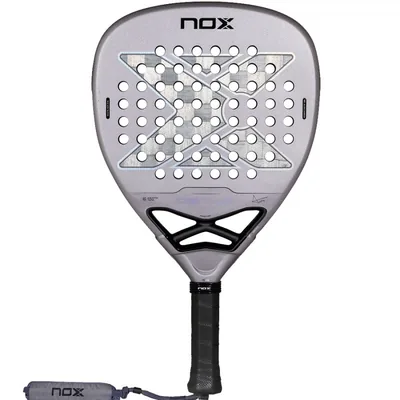
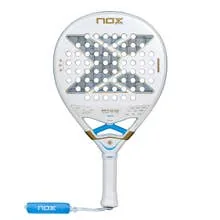
Agustín Tapia’s Nox AT10 Luxury Genius 18K Alum 2026 is a hybrid racket for advanced players who value forgiveness and joint comfort over raw power. Its medium feel and generous sweet spot make it easy to keep the ball moving at moderate pace, though it absorbs more impact on flat smashes than its 12K sibling.
Our verdict is clear if you build points from the back of the court and want to defend and hit block volleys at the net without punishing your arm. If your game relies on bringing the ball back to your side with pure power, however, you will find its top-end punch a bit limited.
- Best for
- Advanced counter-attacking players who want forgiving defense, quick hands at the net, and an arm-friendly feel.
- Not for
- Pure power hitters looking for maximum ball speed on flat smashes or a stiff, highly reactive feel.
Strengths
- Generous, well-centered sweet spot from the back of the court
- Dual 3D textured and sandy finish that grips the ball well
- Arm-friendly feel for long matches
- Easy ball exit at low pace without losing control on block volleys
- Interchangeable 2 g and 4 g weights to raise the balance
Weaknesses
- Less flat smash power than the 12K XTREM version
- Drops ball speed on high, off-center hits
- Requires closing the wrist on the vibora so the ball does not float
01 Back of the court: comfortable defense and controlled ball exit
Digging out low balls near the back glass is straightforward thanks to a wide sweet spot that bails you out when stretched. At low and medium speeds, the ball comes off the face easily without needing a full swing, making it simple to hit deep lobs or play safely out of the corners.
When the rally speeds up, the racket absorbs part of the impact rather than launching the ball uncontrollably. It produces less ball speed than stiffer options like the AT10 12K XTREM or the EA10 Ventus Hybrid, but in exchange it keeps hard-hit shots in check so they do not fly into the back glass.
02 Volley: quick hands and solid block volleys
At the net, it handles with plenty of agility to get the racket in position during fast exchanges, helped by a 360 to 375 g weight range and a medium 260 mm balance. On block volleys and placement volleys, the ball finds depth with very little effort.
When you punch an attacking volley, the firmer part of its dual-density core holds the ball and keeps it from flying off the face. Only when you catch the ball high and off-center does the response turn deader and lose weight on the shot.
03 Overheads: heavy spin on the bandeja, less flat punch
The bandeja and vibora get plenty of bite this year thanks to the 3D textured and sandy finish spread across the entire face, which keeps the ball from skidding on sliced shots. Because the head feels light, you need to follow through firmly downward when accelerating the vibora so the shot stays heavy and does not float.
On the x3 smash, it responds well when you catch the center and use topspin. Where it gives up ground is on the flat smash: the ball sinks deeper into the face and takes more effort to power out than with the 12K XTREM, though adding the weight inserts to the head lets you put up to 8 g of extra mass up top.
04 Feel and comfort: medium stiffness that protects the arm
Pairing the MLD Black EVA core with the 18K Alum Carbon face gives a medium stiffness where you feel the ball sink in before it releases. It is a less crisp response than the 12K models in the same line, built for players who want advanced performance without overloading their elbow.
05 What changes from the 2025 version
In stiffness, core response, and sweet spot size, on-court feel stays the same as the 2025 edition. The real upgrades are on the faces, which drop the smooth areas to extend the sandy finish across the entire surface, and in the new mold with improved airflow and a head-weight system to customize the balance.
Frequently asked questions
- What racket does Agustín Tapia play with?
- The Argentine plays with this season's AT10 18K, a hybrid racket built for mid-pace control and fast hand speed on block volleys and in defense.
- What is the difference between the AT10 18K and the 2026 12K?
- The AT10 18K has a softer feel, forgives off-center hits more easily, and offers easier ball exit. The 12K is firmer and more demanding, rewarding you with sharper overhead accuracy and heavier flat smashes.
- Is it worth upgrading from the 2025 model to the 2026 AT10 18K?
- Stiffness and baseline play are virtually identical between the two editions. Upgrading only makes sense if you want the extra spin from the full-face textured finish or the ability to tune the balance using the frame weights.
- Is the AT10 18K good for players with elbow pain?
- Yes, it is one of the most joint-friendly high-end rackets available. It absorbs impact vibrations well and is easier to handle and less taxing on the arm than more aggressive rackets like the Bullpadel Vertex.