
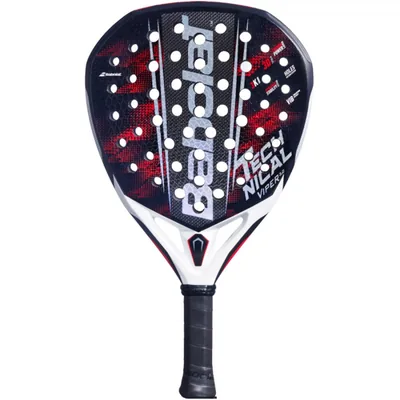







PadelGuru analysis
Verdict
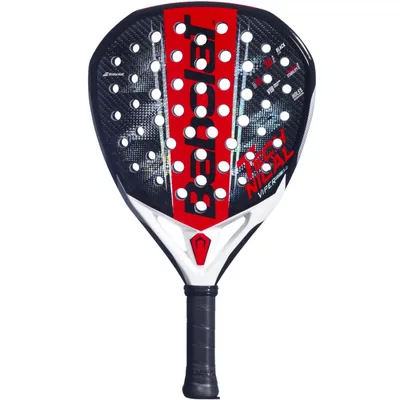
The Babolat Technical Viper 3.0 is built for advanced, attack-minded players who win their points at the net and overhead. On the smash it behaves like a true power racket. When it’s time to defend, though, it gives you nothing for free: from the back of the court you have to set up every shot properly.
We recommend it mainly for players on the backhand (left) side. If you spend much of the match defending off the back glass and need a racket that gets you out of trouble, the Viper 3.0 will make you work for every ball.
- Best for
- Advanced left-side players with solid technique who finish points with the smash.
- Not for
- Players who defend a lot from the baseline and need the racket to supply the ball exit.
Strengths
- Flat and x3 smashes with plenty of acceleration
- Very solid, firm feel on every hit
- The textured face lets you put spin on volleys
- Lively response without having to push the ball
Weaknesses
- Defending requires a well-prepared swing
- A little heavy to move from the back of the court
- Viboras and bandejas fly off the face more than you'd expect
- The sweet spot is on the small side for how stiff it is
01 Baseline: it wants clean contact
The back of the court is where the Viper 3.0 asks the most of you. At 360-380 g with a fairly head-heavy 267 mm balance, it takes a bit more effort to move in defence, and if you’re late it won’t help you dig the ball out of the back glass. Ball exit is restrained, so a shot that isn’t properly prepared tends to land short.
Hit it cleanly and the picture changes. At medium and medium-low pace, the ball comes off the face more easily than with the Viper JL 3.0. It’s a defence that works if you already know how to position yourself; if you still struggle from the baseline, it falls short.
02 Volleys: quick reactions and spin
At the net it reacts quickly in fast exchanges, and the textured face makes it easy to slice the volley and load it with spin. The catch is the fairly high balance: when the ball comes straight at your body, it asks for a bit more arm than a head-light racket would.
03 Smash: its strongest card
Overhead is where it shows its full potential, playing like a power racket in every sense. The Hard EVA + Carbon Power Layer core sends the ball back with a very pronounced trampoline effect, which makes it easy to generate pace on both the flat smash and the x3.
The trade-off comes on the control shots overhead. Viboras and bandejas carry more than you’d expect, and until you adjust your swing the odd one will sail long. It’s a matter of getting used to holding your arm back slightly.
04 Feel: genuinely stiff
This is a stiff racket, firmer than what’s usually called medium-hard, with a very solid, firm feel on every impact. The sweet spot is standard in size, which is only just enough given how rigid the frame is, so you’ll want to find the centre of the face.
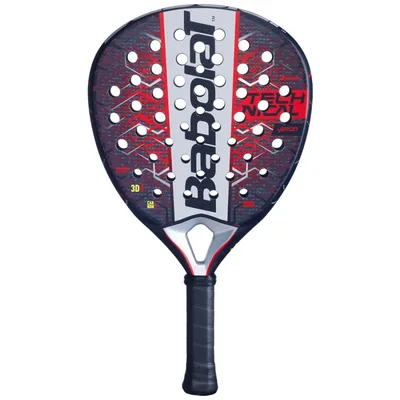
The surface combines a 3D textured raised finish with a sandy finish, for medium roughness overall.
05 Versus last year: stiffer, with a shorter grip
The 3.0 is a touch stiffer than last year’s model. The face now uses 3K Carbon instead of the 12K carbon found on previous Vipers, and the grip has been shortened to 12.5 cm, noticeably less than before. If you’re used to a long handle, check it in your hand before making the switch.
Frequently asked questions
- Is the Viper 3.0 a stiff or soft racket?
- Stiff, and slightly more so than its predecessor. It sits above medium-hard, so you feel a firm response on every shot.
- What's the difference between the Viper 3.0 and the Viper 2.5?
- The new model is stiffer, swaps the 12K carbon face for 3K, and comes with a clearly shorter 12.5 cm grip.
- How good is the Viper 3.0 for smashing?
- Very good, whether you hit flat or go for an x3. The core returns the ball forcefully, so the power comes without you having to force the motion.
- How does the Viper 3.0 handle viboras and bandejas?
- For such a stiff racket it gives more ball exit than you'd think, so judging depth is tricky at first. Until your swing is dialled in, use a little less arm.
- Is the Viper 3.0 better for the right or the left side?
- We see it clearly as a left-side racket: its punch overhead and demanding defence suit players who close out points in the air, not those who build from the back.