
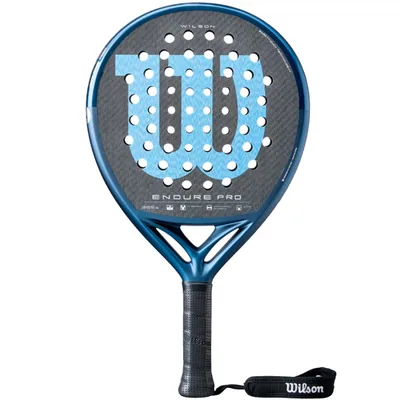







PadelGuru analysis
Verdict
The Wilson Endure Pro V1 2026 is a control racket for technical players. It places the ball with real precision and turns aggressive once you let your arm go, but it gives you nothing back when the contact isn’t clean. This is Momo González’s racket and the most demanding model in the Endure family: drier, with more mass behind the ball, and with a sweet spot you have to find in the centre of the face.
We recommend it to players who already have a solid stroke and would rather set the pace of every ball themselves than let the racket do it for them. If you need a racket that gets the ball over with a short swing, or you want to put the ball out x3 without much effort, the Endure Pro will ask more of you than it gives back.
- Best for
- Advanced counter-punchers with good technique who hit cleanly off the centre and put control first.
- Not for
- Players who want easy ball exit at slow pace, or a big smash without polished technique.
Strengths
- Very fine control over pace and direction
- Solid block volleys that don't fly into the back glass
- Fast, heavy ball when you accelerate through the centre
- Lets you hit hard all match without loading the arm
- Textured face that holds up well over time
Weaknesses
- Away from the centre it turns stiff and the ball dies
- At slow pace you have to lengthen the swing and follow through
- Getting the ball out x3 is very hard work
- On the vibora and bandeja you have to snap the tip downwards
01 Back of the court: solid at pace, sluggish when it slows
When the rallies speed up from the baseline, the Endure Pro is in its element. The ball comes off firm and goes exactly where you sent it, and on defence the racket adds a touch of pace without the ball getting away from you. It’s one of the situations where it performs best.
The trouble comes with slow balls. On a chiquita or a defensive shot with no pace on it, the ball lands shorter than you expect unless you lengthen the swing and follow through. At 355 to 375 g and with average maneuverability, it reaches awkward balls comfortably and doesn’t tire you out, though it isn’t the quickest racket in its family, and on scrambling defence it takes some technique to get it into position in time.
02 Volley: secure blocks, tip down to attack
At the net it blocks very well. When the ball comes in hard, the racket absorbs it and keeps it off the back glass, which you’ll appreciate in fast reflex exchanges. The flip side is that at low pace it barely pushes the ball: a volley without follow-through drops short, although close to the side wall that lack of help works in your favour, because you can place the ball without fear.
To attack, you have to supply the effort. Lengthen the swing and bring the tip down through the ball and it travels with weight; hit it flat and it floats. The backhand volley is the most demanding shot, because that’s where finding the centre and transferring your weight properly is hardest.
03 Overheads: precise on the vibora, demanding on the smash
On the vibora and the bandeja it’s very precise if you strike with the centre: the ball comes off fast without needing a big swing. With a medium 260 mm balance the weight isn’t in the head, so to make the ball drop and carry weight you need to snap the tip downwards; otherwise it goes out flat and ends up in the back glass. Because the sweet spot sits in the centre, the high contacts that are common on these shots feel drier and lose pace.
The smash isn’t its main weapon. With good technique and a centred hit the ball climbs with power and the racket accelerates well, but extracting power is harder than with a Bela Pro or a Defi Pro. The x3 smash is where it struggles most: you have to strike it very well and with spin to get the ball out, and bringing it back into the court is a risky play in a match. If you’re coming from another round racket you’ll adapt quickly; from other shapes you’ll need to get used to hitting lower on the face.
04 A dry feel you notice on every hit
It’s medium in stiffness with a distinctly dry feel, the kind that lets you sense the ball on every shot. The dual-density Control Foam+ core and the 3K Carbon face give it a direct response that conveys a lot of control but punishes off-centre contact: away from the centre the racket goes stiff, the ball comes off without force and even the sound changes.
Despite that firmness, you can hit hard for the whole match without loading the arm. The grip is slimmer than on earlier Wilson models such as the Bela. The sandy finish is rough, like a file, though less pronounced than on other sandy-finish rackets, which somewhat limits how much weight you can put on the ball; in return, the texture holds up with use.
05 For the counter-puncher who builds the point
We see it as a racket for the counter-puncher who builds the point with precision and puts the ball away when the chance comes. It competes with rackets like the Combat Fuji, which has a similar stiffness, the Haque Hybrid and last year’s AT10 12K.
If you struggle to generate pace, the Endure LS in the same family drives the ball more easily, and we think it’s the more sensible choice.
Frequently asked questions
- Which racket does Momo González use?
- Momo González plays with the Endure Pro, the top model in Wilson's Endure line. It's a round racket with a medium balance, built more for constructing points than for finishing them overhead.
- Is the Endure Pro stiff or soft?
- Medium, but with a crisp, direct response: you feel the ball clearly, and mishits come through as harsh and rigid. It's a shade drier than the Endure V1.
- Is the Endure Pro good for smashing?
- It smashes well for players with sound technique who catch the ball in the middle of the face, which sends it up with plenty of power. Contact near the top of the head costs a lot of pace, and putting the ball out x3 is a real struggle.
- How is the Endure Pro different from the Endure V1 and Endure LS?
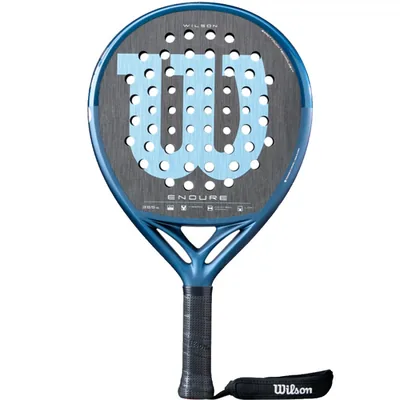
- The Pro carries more mass and inertia and hits a flatter, straighter ball from the baseline, at the net and overhead, but it's less maneuverable than the V1. Of the three, the LS offers the easiest ball exit.
- Is the Endure Pro hard on the arm?
- Not particularly. The feel is dry, yet you can keep hitting firmly from the first game to the last without your arm paying for it.