







PadelGuru analysis
Verdict
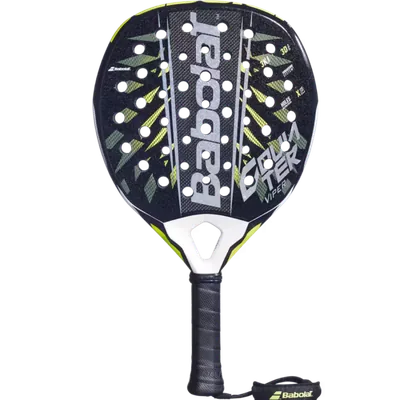
The Babolat Counter Viper 2.6 is a round control racket for advanced, technical players who still want to attack. Its vibora and smash hit harder than you’d expect from a racket of this shape. The large sweet spot sits low, close to the hand, which makes it easy to place the ball precisely.
The trade-off is that it gives you nothing for free at low pace. Ball exit is moderate and the feel is dry, so it plays best when rallies are quick and you know how to accelerate the ball yourself. If you want a racket that bails you out from the back of the court, look elsewhere.
- Best for
- Advanced, technical players who want control from the baseline plus a vibora and smash with real punch.
- Not for
- Players who need the racket to help them defend slow balls, or who want a soft, comfortable feel.
Strengths
- Powerful smash for a round control racket
- Aggressive vibora and bandeja that stay accurate
- Large, low sweet spot close to the hand
- Long handle gives extra leverage on attacking shots
Weaknesses
- Gives little help in defence when the ball arrives slowly
- Its balance tires the arm during long defensive spells
- Dry feel, more noticeable on high contacts
- The texture wears off with use
01 Baseline: precise, but the power has to come from you
At the back of the court it’s accurate, but you supply the power. On slow balls it bounces the ball back a little more than a pure control racket does, though not enough to make defending easy. If you just hold the racket out, the ball lands short. It works far better for technical players who set up the shot and accelerate off the back glass.
You feel the 265 mm, slightly head-heavy balance when defending. Maneuverability isn’t its strength there, and when you have to react several times in a row near the glass, the physical effort adds up over a match.
02 Volleys: decent handling if you pick the right unit
At the net, handling is average, neither slow nor especially quick, and it depends a lot on which weight you end up with in the 355 to 375 g range. Below roughly 365 g it moves like a standard racket in fast exchanges. Above that, combined with the balance, it starts to feel heavy on reflex volleys. If you get the choice, go for a unit at the lighter end.
Off the sweet spot, volleys lose depth. If you don’t follow through, the ball falls short and gives your opponent the chance to attack.
03 Overheads: where it really shines
The vibora and bandeja are the best part of this racket. You can swing freely and play them with attacking intent without the ball getting away from you. The long 14 cm handle adds leverage, which is why it attacks better than a typical round racket.
On the flat smash it ranks among the most powerful control rackets, and it still responds well when contact drifts towards the top of the face, although the feel gets drier up there. The x3 smash is another matter: with moderate ball exit, putting the ball out of the court takes good technique and a fully loaded swing.
04 Dry feel and a texture that wears smooth
This is a medium-stiff racket with a dry feel. The X EVA core and 3K Carbon face give you direct feedback on every hit. That helps precision, but there’s very little cushioning. If you’re coming from soft rackets, you’ll notice the difference.
The face pairs a light 3D textured finish with a sandy finish, and the sandy finish is what you feel most under your fingers. The texture fades over time, so the grip on the ball you get in your first few matches won’t last.
05 The middle ground of the Viper family
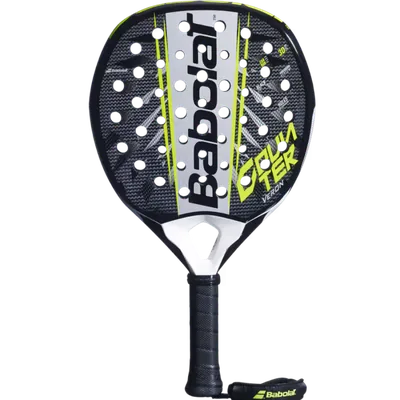
Next to its siblings, the Counter Viper 2.6 sits in the centre. It’s softer than the Technical Viper and stiffer than the Air Viper. It’s easier to handle than the Technical but slightly harder than the Air, and its rebound at low pace also falls between the two. On the smash, only the most powerful of the three beats it. It doesn’t top any single category, but it always comes second. If you’re torn between the three, it’s the most balanced bet.
Compared with the Viper Soft, it gives up a little power but helps more with rebound. For an advanced player who wants attacking control without being left completely on their own when the ball arrives with no pace, we think it’s a very sensible choice.
Frequently asked questions
- Is the Counter Viper 2.6 stiff or soft?
- It sits on the stiffer side of medium, with a dry response. Comfort isn't its strength, but you always know exactly what the ball is doing off the face.
- How good is the Counter Viper 2.6 for smashing?
- Very good by round control racket standards. Flat smashes come off hard even on high contacts. Taking the ball out x3 is tougher, because the racket adds little ball exit, so your technique has to do the work.
- Counter Viper, Technical Viper or Air Viper: which should I choose?
- Choose the Counter if you don't want to go to either extreme. The Technical suits players who want the stiffest frame, while the Air is the pick for the easiest handling and the most rebound.
- How much does the Counter Viper 2.6 weigh?
- Units range from 355 to 375 g. Ideally stay at or below about 365 g, since the heavier ones feel sluggish on fast volleys.
- Does the Counter Viper 2.6's texture last?
- Only partly. The 3D texture is subtle to begin with, and the sandy finish, which gives most of the grip, wears down the more you play.